Who am I?
First and foremost, I am a family man and a member of this community. I am a retired military veteran and a graduate-level social work student. I am a local business owner. Each of those factors make me who I am today and who I will be in the future. My personal values of Family, Service to Community, Honor, and Integrity are the forefront of everything I do and have done. My military history has instilled pride and has provided many experiences that have conditioned me to lean into challenges and to tackle difficult situations and projects. I may not have been born and raised in Richland Center, but I have been a member of this community and a business owner since 2018. This is where my family calls home, works, and goes to school.
What do I stand for?
My military and social work roots mean that I work for people in the sense of helping them to overcome their problems and better their lives. I stand for an approach to the mayorship that models our approach to social work. That is, an approach that is strengths-based and not focused on what cannot be done or why. We are often faced with limitations throughout our life, but If we are constantly looking for dead ends, restrictions, and limitations, we will overlook the positives instead of focusing on the community’s abilities, potential, and current resources. What is accomplished in the coming years will depend mostly on how our resources, potential, abilities, and strengths are organized, managed, and utilized. In adopting this mentality and overall approach to the community, we recognize that limitations and restrictions will occur, but we will be more equipped to work through those limitations and find solutions that emphasize the community’s strengths.
I stand for collaboration. Collaboration not only between the common council and myself, but between the government as a whole and all citizens; not just registered voters. What does collaboration look like? A term synonymous with collaboration is team work. However, I believe that collaboration is much more than team work. Team work, while important, is a group of people working towards a common goal. While that is certainly what we as a community should be doing, collaboration is a more accurate term. So, what is collaboration?
There are a few definitions, all similar, but in my professional experience, I have found collaboration to be much more than coming together to achieve a common goal. Respectful communication is a major part of collaboration. We do not have to agree. Nobody ever fully agrees with another person or group of people. We are all different and are the sum of our education and knowledge, beliefs and values, and experiences. In fact, I believe that our differing opinions and perspectives fall under our resources. Everyone has some degree of knowledge about a subject that impacts this community. As such, collaboration is the sharing of that knowledge and those perspectives that add to working towards a common goal. What is that common goal? I believe it is community growth; not just physically and geographically, but also socially and emotionally. While community growth involves so much more than specific tasks and projects, the important thing here is that I want to see us collaborate. I want to see the city government engaging with the community, and the community with them. Nationally, engagement with and by citizens has declined over time. Richland Center is no different. How many of the 2,797 registered voters in the city do you think regularly engage with their elected alder or other members of the government? Have you? It is difficult to determine an exact number, but I will say that engagement has been very low. I have been to several council and committee meetings over the years, and there was only a couple in which seating was limited.
I believe that we need to have the difficult conversations. Everyone deserves to be listened to and heard regardless of the issue. But in order for that to happen, people need to be willing to talk and share their opinions, perspectives, and experiences. Does that mean that everything that is done in the coming years will please everyone or prevent some people from feeling frustrated and unheard. No, of course not. But the more of the community that engage, provides input and feedback, and involves themselves in the process of growth and change, the more likely that growth and change will be accepted.
I stand for advocacy and recognize that every single one of us have needs and wants we would like met. In my clinical work, we use theoretical framework to guide our treatment planning and execution of that plan. I’m not going to bore anyone with the specifics of theory, but what I will say is that it suggests that we prioritize our needs and wants whether we know it or not. We prioritize our needs based off of importance, and it is believed that our needs are organized by physical, safety and security, love and belonging, and self-esteem. For example, if you are struggling with being able to afford food and you don’t know when your next meal is coming, are you able to focus at work or school and accomplish what you need to? No, probably not. Also, fulfilling needs and wants becomes more complicated when we have to compare the needs of individuals to the needs of groups and then to the needs of the community.
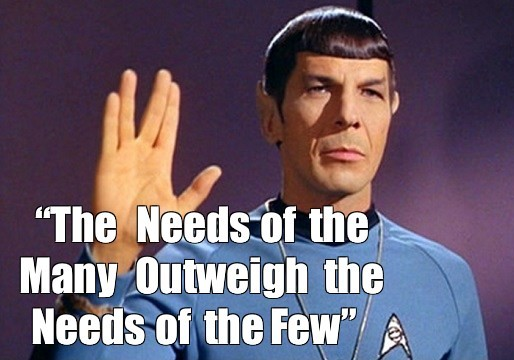
Growing up in the family I did, Mr. Spock became a sort of mentor to me. His quote, “The needs of the many outweigh the needs of the few” rings true for the most part. As Mayor, my responsibility is to the community as a whole, which means I must acknowledge and understand the community’s needs and wants. However, that does not mean that an individual’s or a group’s needs are not important. In many cases, individual needs align with group and community needs. Nonetheless, sometimes everyone needs help with meeting a need. That help often comes in the form of advocacy.
Advocacy has been an important part of the work I have been doing for nearly the past decade, not to mention during the time I led Soldiers in the Army. Any person in an elected position really has to include advocacy in their interactions with the community and with their collogues across the city government. Without it, needs go unmet, which in turn impacts the community. Advocacy requires community outreach, effective communication, knowledge, research, and planning. But it also requires a desire within the person to advocate for others, which takes empathy and conscious effort towards finding solutions while compromising and negotiating. At the level of city government, and especially the mayor’s office, this translates to social justice and working to fulfilling the community’s needs.
I stand for fact-based and data-driven decision-making, especially in situations where decisions impact so many people. Nothing I have talked about up to this point works very well without factual information and understanding the data behind those facts. Without factual information, no decision made after the fact will be accurate and may even be detrimental. A lot of my education and training includes research skills necessary to find and interpret study designs, data, and outcomes. Just as important is the ability to communicate that information to the community, especially when it drives decision-making that will impact the community.
The term research is a broad term that encompasses many methods of research. Research can be time consuming and expensive, or it can be brief and inexpensive. The more complex something we want to know is, the more complex the process of research becomes. Most of us engage in research when we look for information on Google. Ideally, the more of a mix of information, the more likely we can draw accurate conclusions. As you will see as time progresses, the information I will present for the purposes of informing the community and for decision-making will come from multiple sources. Sometimes it may include comparison of data from multiple sources and sometimes it may contain statistical analysis. Other times, information will be backed by survey research data. Survey research will be the most commonly used by me to solicit responses from the community. The first will soon be available to complete through this website. Survey research can be be complex depending on how it is used, but in its simplest form it will provide me with opinions, ideas, and feelings of the community that will help guide me.


I stand for accountability. Personal accountability and accountability to the citizens of Richland Center. It means taking responsibility for the consequences of our actions and decisions. Accountability is something that must occur and must be part of a leader’s character. As mayor, I will be accountable to the citizens of Richland Center, and I work to ensure that members of the Common Council and government departments are held to the set standard. Appropriate use of taxpayer money, government and city resources, and working to accomplish what the citizens want are important parts of accountability. Accountability and responsibility for my actions are something that was instilled early in my military career and allowed me to progress as far as I did. I was always accountable to my leaders, and in a way, accountable to my subordinate Soldiers. This will not change.